🇬🇧 English version | 🇳🇱 [Lees de Nederlandse versie]
On Darby, Scofield, Israel, a remarkably noisy “secret” rapture, and why I’d rather endure than escape.
The rapture. In Dutch we usually call it de opname van de gemeente – the catching up of the church.
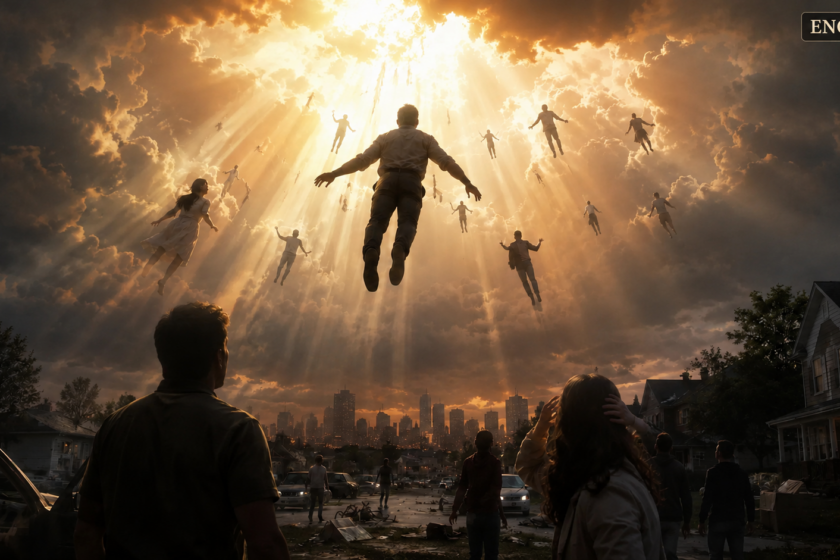
You probably know the shape of it by now, mostly thanks to American preachers, movies, and paperbacks. At some unannounced moment, every true Christian vanishes off the face of the earth.
Cars roll on without drivers, planes lose their pilots, and everyone left behind is stuck working out what on earth just happened.
Then the Great Tribulation begins, the Antichrist steps forward, the world slides into chaos, and eventually Jesus comes back visibly to sort it all out.
If you grew up inside this teaching, it’s easy to assume Christians have always believed it – as though Jesus and the apostles handed us the whole timeline, tidy and complete, and there’s simply nothing left to discuss.
Sometimes it goes further than that. In some circles, if you don’t believe in the rapture, you apparently don’t believe the words of Jesus.
People are welcome to say that, as far as I’m concerned. But it ends the conversation in a single sentence, and it claims an authority no interpreter of Scripture gets to claim. Misplaced authority, if you ask me.
I don’t want to do this as though one of us is standing over the other. So let’s go back to the text – traceable, black on white, read in context. Not my reading as the last word. Not yours either. Our interpretations stay human work, mine included. That’s the whole spirit I want to do this in.
Here’s the thing worth saying up front. The rapture doctrine as it’s taught today, especially in evangelical and fundamentalist circles, is less than two hundred years old as a fully worked-out system. That doesn’t mean somebody pulled it out of thin air. The Bible really does talk about Christ’s return, the resurrection of the dead, and believers going out to meet Him. But between those passages and the complete rapture timeline stands a whole scaffolding of interpretations, divisions, and assumptions.
That scaffolding is what I want to walk around – preferably without the smoke machine, the countdown clock, and the map of the Middle East glowing in the background.
First, keep two things apart
Historic Christianity teaches that Jesus will return, that the dead will rise, that judgment will come. That’s not a modern invention. The ancient creeds already confess Christ returning to judge the living and the dead, the resurrection of the dead, and the life of the world to come.
What the creeds do not mention is a separate disappearance of the Church, years before Christ’s visible return.
Paul does write, in 1 Thessalonians 4, that believers who have died will rise, and that those still alive will be caught up together with them to meet the Lord in the air. The Greek word there means to seize, to snatch, to take suddenly; through the Latin it eventually gave us the English word rapture.
So no – the word wasn’t invented by an American television preacher with unusually good teeth. It’s genuinely in the text.
But a word in the text is not the same as a timeline around it. Paul says believers go out to meet Christ. Modern rapture theology bolts an entire seven-year schedule onto that sentence.
Those are two different things, and most of this article lives in the gap between them.
What people actually mean by “the rapture”
There are several versions, but the famous one is the pre-tribulation rapture: the Church caught up before the Great Tribulation.
The timeline runs roughly like this.
First, Jesus comes unexpectedly and removes the Church; true believers disappear.
Then a period of tribulation falls on the earth, usually reckoned at seven years, and the Antichrist rises.
At the end of it, Jesus returns again, this time visibly, to the whole world.
After that comes the millennial kingdom, and finally the last judgment and the new heaven and new earth.
Which leaves you with two moments when Christ comes: first for His Church, later with His Church.
Supporters call these two phases of one Second Coming.
Critics say it sounds an awful lot like two comings – the first of which never gets described in full in any single clear passage.
I lean toward the critics, and I’ll show you why as we go.
None of this floats free, either. The rapture belongs to a larger system called dispensationalism, which divides history into distinct periods, or dispensations, and draws a strong distinction between Israel and the Church.
On this view, God is dealing chiefly with the Church in the present age; once the Church is raptured out, His prophetic program for Israel takes center stage again.
And that’s where I have to stop, because when I open my Bible I don’t find two trees.
I find one.
One olive tree, not two separate tracks
In Romans 11 Paul reaches for an image to explain how Jews and Gentiles fit together in God’s covenant: an olive tree.
The natural branches are Israel.
Believers from the nations are wild branches, grafted into the tree that’s already there.
They don’t plant a second tree.They don’t replace the first one.
By grace they get to draw on the root that holds them up – God’s promises to Abraham and to Israel.
As I read it, Paul is not presenting Israel and the Church here as two unrelated peoples of God moving along completely separate covenant tracks. He’s describing one tree.
The promises to Israel converge and come to fruit in Jesus, and in Him Jews and Gentiles don’t become two parallel communities with two separate roots. They share in the same covenant story.
That doesn’t mean Israel gets discarded, or that the Church has shoved Israel aside and taken its seat.
It means Gentile believers were brought into a covenant story that was already long underway before they showed up. They were added, they didn’t take anyone’s place.
No new tree, and certainly no spiritual logging permit – just wild branches, graciously grafted in.
And Paul turns and warns those wild branches, in as many words, not to get arrogant toward the natural ones. They don’t hold up the root. The root holds them up.
So within dispensationalism the rapture isn’t just one doctrine among others. It does structural work: the Church has to be cleared off the stage so the rest of the timeline can run.
And the moment you stop accepting that hard split between Israel and the Church, a load-bearing wall of the whole thing starts to lean.
The Reformation didn’t do this
People sometimes assume this teaching goes back to the Reformation. It doesn’t.
The Reformation was the sixteenth century. Modern rapture theology didn’t take shape until the nineteenth. That’s more than three hundred years of daylight between them.
What the Reformation did do, indirectly, was create the conditions for new readings to grow: Scripture became far more widely available, Protestants rejected Rome’s central authority, and over the following centuries the landscape filled up with churches, movements, and independent Bible groups, each free to read for themselves.
The name that matters most in the modern system is John Nelson Darby, an Anglo-Irish preacher who lived from 1800 to 1882. In the first half of the nineteenth century he built and spread a coherent end-times system in which the Church is caught up before the tribulation.
You can find older writings with scattered elements that resemble pieces of it, but Darby is the one who assembled it into a developed system, organized it, and carried it far.
He crossed to North America several times, and his ideas landed in exactly the right soil: evangelical preachers and prophecy conferences already hungry for a map of the end.
And then came Cyrus Scofield.
A Bible with the interpretation printed underneath
The first Scofield Reference Bible appeared in 1909, with a revised edition in 1917.
Scofield hadn’t written a new Bible.
He took the King James text and wrapped it in extensive notes, cross-references, and prophetic charts, so that his dispensational reading sat literally beside and beneath the words of Scripture.
That turned out to be enormously effective.
What had been the reading of a fairly narrow nineteenth-century movement was now lying open on the kitchen tables of ordinary Christians everywhere.
And there’s a quiet danger in that arrangement.
When the explanation sits directly under the text, it gets very easy to feel that the words above and the words below carry the same weight.
Before long you’re no longer reading:
this is what Paul writes.
You’re reading: this is what Paul writes, and therefore it means exactly what Scofield put underneath.
But a footnote doesn’t become inspired by the Holy Spirit just because it happens to share a page with Scripture. It’s still human commentary. Good commentary, maybe. But still human.
Then the culture finished the job
Across the twentieth century the rapture worked its way deep into American evangelical life.
Books tied biblical prophecy to wars, elections, and headlines out of the Middle East.
Later the Left Behind novels turned the whole thing into a globally recognizable disaster story.
At that point the rapture stopped being merely a doctrine and became a story – vanished people, war, conspiracies, world leaders, an Antichrist, and a knowing remnant who understand precisely what’s really going on while everyone around them stumbles in the dark.
I’ll admit it: that’s a better story than the one Jesus actually told. No one knows the day or the hour. Stay awake. Be ready. Paul adds that we should keep a clear head. You sell considerably fewer end-times thrillers with material like that. Inconveniently enough, it’s what the Bible says – the Word of God, to put it a little sharply.
From the exciting story back to the text
The passage at the center of all this is 1 Thessalonians 4. Paul is writing to Christians who are anxious about believers who’ve already died.Have they missed Christ’s return?
Paul reassures them: the dead in Christ will rise, and those still alive will be caught up together with them to meet the Lord.
The heart of it is comfort.
And at the end Paul doesn’t say: “Now convert this into a timeline with seven years, two appearances, and forty-eight prophetic arrows.”
He says: “Encourage one another with these words.”
The passage is about hope for Christians who have died. It is not, first and foremost, an escape hatch from a future global catastrophe. It’s also not a quiet scene, by the way.
The moment comes with a command, the voice of an archangel, and the trumpet of God.
Hardly background music.
1 Corinthians 15 gets pulled in too.
There Paul writes that not everyone will die, but that living believers will be changed when the dead are raised – and this happens, he says, at the last trumpet.
Again: clearly a real biblical expectation.
What the passage does not say is that this transformation happens seven years before Jesus appears.
Other proof texts get drawn from John 14, Revelation 3, and Matthew 24, and yes, each one can be slotted into the rapture timeline. But the timeline itself is never written out anywhere as a single sequence.
It has to be assumed first, and then laid like a transparency over passages that were doing other things.
You end up hopping from text to text until the pieces line up.
Where it starts to rub
The “secret” rapture makes a remarkable amount of noise.
In 1 Thessalonians 4, Christ comes down with a command, an archangel’s voice, and God’s trumpet; the dead rise, and believers go out to meet Him. You can read that as sudden – fine.
What you can’t get from the passage is that it’s silent and hidden.
The hush comes from the system, not the text.
Jesus gathers His elect after the tribulation.
In Matthew 24 the Son of Man appears after the tribulation of those days, and then His elect are gathered from the four winds at a great trumpet blast.
Which sounds strikingly like Paul: Christ appears, a trumpet sounds, believers are gathered.
The pre-trib response is that Matthew 24 isn’t about the Church at all. It is understood as referring to Israel, or to people who come to faith after the rapture.
That interpretation deserves to be taken seriously.
But the passage itself does not explicitly make that distinction.
That distinction comes from the broader interpretive framework rather than being stated directly in Matthew 24.
Paul says some things have to happen first.
In 2 Thessalonians 2 he writes about the coming of Jesus and our gathering to Him, then warns his readers not to be fooled: certain things come first, including the rebellion and the unveiling of the man of lawlessness.
That fits awkwardly with the claim that nothing needs to precede the rapture and that the Church is already gone before the Antichrist is revealed.
To maintain the pre-trib timeline, the interpretation requires additional distinctions between the events and groups being described.
Whether those distinctions are justified is precisely the question.
“One will be taken, the other left.”
These words probably get cited as rapture-proof more than any others.
Two people working side by side; one taken, one left. Straightforward enough – until you read the line right before it, where Jesus compares His coming to the days of Noah.
People carried on with ordinary life until the flood came and took them all away. So who got taken?
Not Noah and his family.
- They were the ones preserved.
- The ones taken were swept away in judgment.
- Now, that doesn’t automatically settle what “taken” means a few verses later.
But it does make this a shaky foundation for a doctrine in which being taken is supposed to be the good outcome.
One Second Coming becomes two distinguishable moments.
The old creeds speak of Christ’s return, the resurrection, and the judgment.
Modern pre-trib rapture theology distinguishes an earlier coming for the Church from the later visible return of Christ after the tribulation. Supporters understand these as two phases of one Second Coming.
That position can be defended by connecting different passages.
What you never simply read is: “First I remove the Church. Then seven years of tribulation. Then I return visibly with the Church.”
For a doctrine sometimes presented as plain, literal biblical truth, that’s a conspicuous absence of one plain, literal biblical passage spelling out the sequence.
Didn’t the earliest Christians believe in a catching up?
They believed Christ would return, absolutely. They believed in the resurrection of the dead, in judgment, in the union of believers with Christ.
Various ideas about tribulation, the Antichrist, and the millennium show up very early too, and the Church Fathers didn’t agree with each other on every detail.
What you don’t find among them is the fully developed modern system :
- the Church removed before a seven-year tribulation
- a separate prophetic program for Israel moving to the foreground again
- Christ coming first for His Church and later returning visibly with it.
That fully developed system belongs primarily to the world of Darby, Scofield, and the American evangelicalism that followed.
Why is it so appealing, though?
I don’t think the pull of the rapture is only about the verses. The system offers order in a chaotic world.
Wars, disasters, upheaval, moral decline, the latest crisis in the Middle East – each gets a fixed slot in a grand timeline.
Nothing is just noise anymore; everything might be a sign the end is near.
And the pre-trib version carries an especially reassuring promise for the people who hold it: we won’t have to live through the worst of it. We get lifted out first.
It hands you a kind of certainty, too. If you think you’ve got the prophetic map, you understand what everyone else is missing.
The newspaper becomes a Bible puzzle, and every fresh catastrophe might be the piece you’ve been waiting for.
I understand the appeal of that, especially when the times are frightening.
But it can grow into a faith that spends more energy decoding wars and politicians and earthquakes than asking how Christ actually told us to live today.
He didn’t tell His followers to draw the perfect timeline.
He told them to keep watch.
To stay faithful.
To love God and their neighbor.
To be ready.
That is not the same assignment.
What can we actually say with confidence?
The Bible teaches that Christ will return.
That the dead will rise.
That living believers will be changed and will go out to meet Him.
Where Christians disagree – and they do, honestly and in good faith – is on the timing, the sequence, and how all of this relates to the Great Tribulation.
The pre-tribulation rapture is one interpretation.
A hugely influential one.
But it is not something Christians everywhere have confessed for two thousand years, and it is not a complete prophetic timeline that Jesus ever spelled out word for word.
You can believe with your whole heart in Christ, His return, and the resurrection of the dead, and still conclude that modern rapture theology is a relatively recent reading that puts more into the texts than the texts themselves plainly say.
That, in the end, is the whole distinction I care about: the difference between the words of Scripture and the structure people later built around them.
How I see it, personally
Set all the systems aside for a moment, and the rapture leaves me with a much simpler question:
what kind of God does this picture give us?
Because in this scheme, people who didn’t come to faith before one particular hidden moment are left to endure seven more years of horror.
One group waits it out safely in heaven while the other goes through war, persecution, and terror.
Christians have been persecuted, tortured, and killed for their faith all through history, in every era, on every continent.
They lived through all of it because they believed, and they were plainly not spared by being lifted out ahead of time.
I have a hard time finding the justice in a system that would have rescued a later generation from what those believers had to walk straight into.
And past the fairness of it, I just don’t recognize my God in this picture.
My God doesn’t hand out penalty points because someone understood something too late.
He’s patient, and merciful, and just. He doesn’t play favorites with the person who happened to catch on sooner than the one still standing in the dark.
The God I worship doesn’t pull the door shut with a contented click while people outside are still crying to be let in. He keeps calling. He keeps meeting people right where they are.
That doesn’t mean choices carry no weight, or that judgment is a fiction. It means I can’t make peace with a doctrine in which salvation starts to look like a matter of timing: believed in time, safely removed; believed too late, first survive seven years of misery.
That sounds less like the Gospel to me and more like a human system that has filed God away into boxes, periods, and prophetic charts.
The Church as Kingdom: already begun, not yet finished
In the Orthodox tradition, the Church isn’t a temporary emergency shelter that eventually has to be evacuated off the earth.
The Church is the Body of Christ – the visible showing-forth, or better, the icon and foretaste, of His Kingdom in the here and now.
Seen that way, the Kingdom of God isn’t something that only switches on at some future date. It has already broken into the world in Christ.
Where He reigns, where people are joined to Him through the Holy Spirit, where the Church gathers around the Eucharist – there the Kingdom is already present. Just not yet complete.
Already, but not yet.
I think that might be the most beautiful phrase in all of theology.
For now we see it in broken, partial form, tangled up with the suffering and sin of the world.
At the Second Coming the Church isn’t first bundled off so God can move on to some other item on the agenda.
What began in Christ is finally revealed in its fullness:
the resurrection;
the judgment;
the defeat of death;
the completion of the Kingdom.
And that quietly changes how a believer stands in the world.
You’re not crouched by an escape hatch waiting to be whisked away before things get bad.
You live now as a citizen of that Kingdom.
You stay faithful.
You carry suffering alongside other people.
You love your neighbor.You try to make it visible, in this ordinary world, who Christ is – not because the world already is the Kingdom in full, but because the Kingdom has already begun right here.
That’s a different story than the one about the escape.
Because underneath all the history and all the proof texts, I keep circling back to one question: What kind of Christian life does the doctrine actually produce?
Is the faith about waiting for a way out? Or about staying faithful, enduring, loving, and following Christ even when the world gets neither safer nor calmer nor easier to read?
For me, the Christian life doesn’t begin with the escape.
It begins right there.
Bible passages used in this article
- No one knows the day or hour: Matthew 24:36, 42, 44
- Stay watchful and clear-headed: 1 Thessalonians 5:6
- Caught up to meet Christ: 1 Thessalonians 4:13–18
- Changed at the last trumpet: 1 Corinthians 15:51–52
- The elect gathered after the tribulation: Matthew 24:29–31
- The rebellion and the man of lawlessness must come first: 2 Thessalonians 2:1–4
- The olive tree and the grafted-in wild branches: Romans 11:17–24
- God’s patience makes room for repentance: 2 Peter 3:9, 15
Ontdek meer van Mijn leven in zijpaden
Abonneer je om de nieuwste berichten naar je e-mail te laten verzenden.